
API management vs. API gateway: what is the difference?
The two terms are often used interchangeably, but they describe different things. An API management platform covers the complete management of APIs: creation, publication, monitoring, analysis and monetisation, plus the management of the users and developers who consume them. An API gateway is one component within it, and the most important one at runtime. It is the entry point for external requests and mediates between external systems and internal API endpoints.
| Criterion | API management platform | API gateway |
|---|---|---|
| Scope | The entire API lifecycle | Runtime handling of API traffic |
| Core job | Design, publish, document, version, analyse and monetise APIs | Route, secure, throttle and transform individual requests |
| Security role | Defines policies, access rights and subscriptions | Enforces authentication, authorisation and rate limits on every call |
| Main users | API owners, architects, developers | Client applications calling the APIs |
| Interface | Web-based management console and developer portal | Server or software component in the request path |
| Standalone use | Usually includes a gateway | Can run without a management platform |
What an API management platform does
- It is a comprehensive solution with the tools and functions to manage the full lifecycle of APIs.
- It covers creating, testing, deploying, monitoring and documenting APIs.
- It lets organisations design, develop and maintain APIs while keeping them secure, scalable and performant.
- It typically includes authentication, authorisation, quota management and analytics.
- It usually offers a web-based interface for managing APIs, so API owners do not need to work at code level.
What an API gateway does
- It is a single server or software component that acts as the interface between clients and multiple APIs.
- It works as a central switching point: it accepts incoming client requests, forwards them to the right API and returns the responses.
- It provides routing, security (authentication and authorisation), rate limiting and logging.
- It can transform data formats and aggregate several APIs into a single one.
- It is usually part of an API management platform but can also be used on its own.
Do you need both?
In most enterprise landscapes, yes. A gateway on its own can secure and route calls, but it cannot tell you which APIs exist, who owns them or when an old version can be switched off. A management platform without a gateway has nothing that enforces its policies at runtime. Used together, the platform defines the rules and the gateway applies them to every request. If you are also deciding how internal systems should talk to each other, our comparison of ESB vs API management shows how both layers fit into one integration strategy.
What should good API management software do?
API management tools differ widely in scope. Whatever the product, good API management software should cover these requirements:
- API design tools to create and document APIs.
- An API gateway that acts as the intermediary between the consumer and the API, processes requests and returns responses.
- Support for security protocols that protect against unauthorised access and attacks, such as OAuth 2.0, OpenID Connect and JWT.
- API monitoring and analytics that track performance and identify weaknesses immediately.
- Access and subscription management for user access, authentication, authorisation, API registrations and subscriptions.
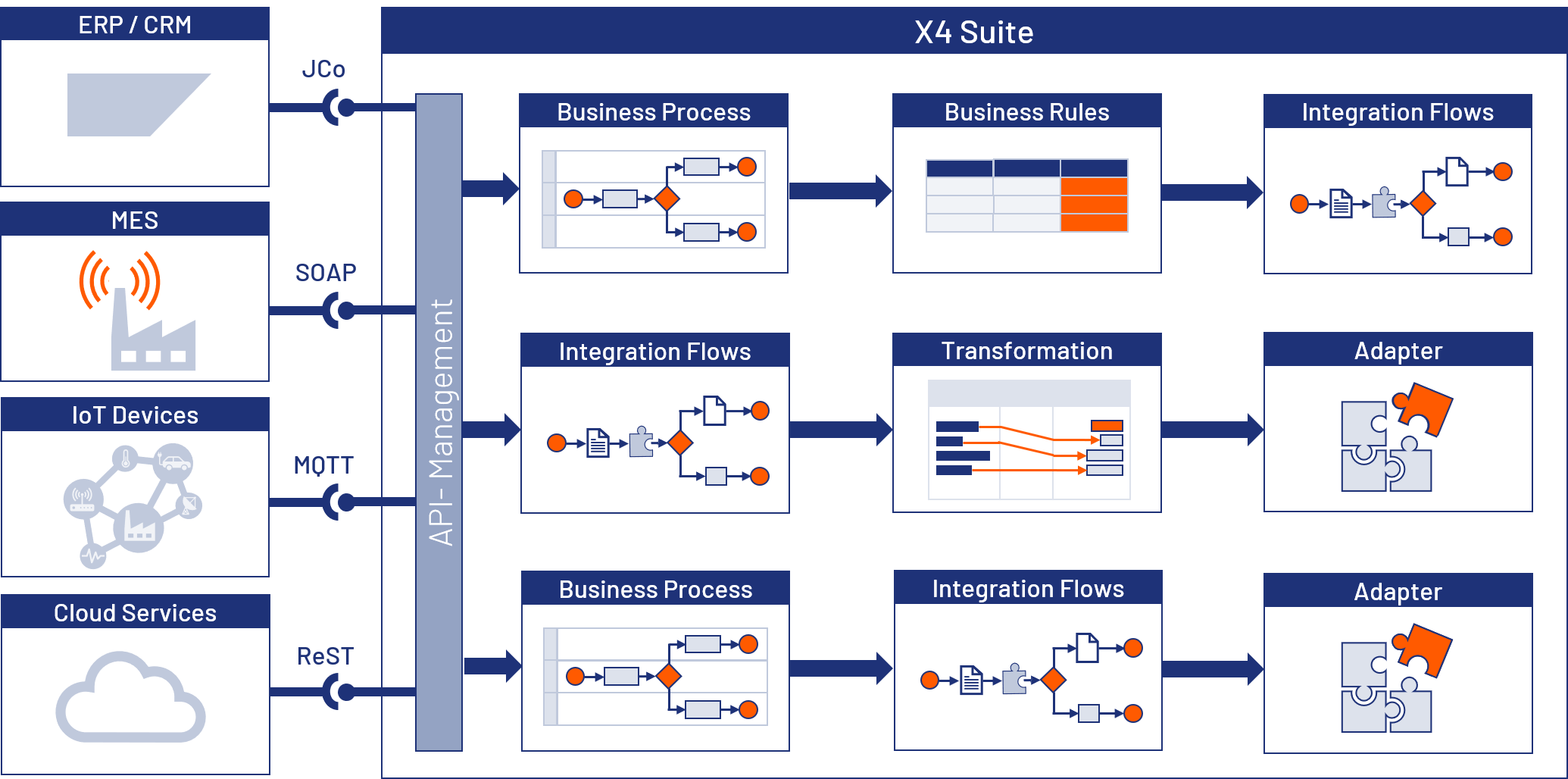
- Integration capabilities so that APIs can connect further systems and applications to the network.
- Scalability to handle a growing number of API requests and users.
- Flexibility to manage different types of API, including REST APIs and SOAP APIs.
- A developer portal where developers can find, register for, read the documentation of and test APIs.
Benefits of API management
- Simpler integration: APIs connect applications seamlessly and support the exchange, aggregation and processing of data.
- Higher efficiency: existing integration resources can be reused to build new functions and services quickly.
- Greater agility: efficient processes let organisations react faster to market changes and stay competitive.
- Better internal collaboration: one platform that integrates all APIs makes it easy to share data between business units and teams.
- Better customer experience: faster, simpler access to data and services raises customer satisfaction and loyalty.
- Lower costs: applications and services that are developed faster are also cheaper to run.
- Stronger security and compliance: security and access controls protect data and support compliance requirements when large data volumes are processed. Gateways use security tokens and access keys to make sure only the right users reach the data, and a central platform with up-to-date data helps detect potential vulnerabilities in real time.
- New revenue streams: API usage can be metered and billed, and valuable data shared with partners under controlled conditions. This is the basis of API monetisation.
Where is API management used?
API management pays off in any industry that depends on digital services and data exchange. Typical examples:
- Insurance and financial services: account information, transactions, payments and claims data exchanged with customers, brokers and partners.
- Energy and utilities: meter data, customer portals and data exchange with market partners.
- Healthcare: secure exchange of medical data and information between institutions.
- Retail and e-commerce: orders, payments, e-invoicing and shipping.
- Transport and logistics: shipment tracking and route optimisation.
- Telecommunications: network management and monitoring of communication services.
Typical use cases
The most common use case is integration: with API management, organisations connect their systems and applications and exchange data efficiently. Mobile applications are another. Here, APIs deliver data in real time and support features such as push notifications and in-app purchases.
Cloud integration is a further example. Companies use APIs to move applications and data to the cloud and to embed cloud services into their business processes, often as part of legacy system modernization. APIs also power IoT applications that collect and analyse data from sensors and other devices. In each case, APIs make it possible to digitalise business processes and drive innovation as part of the wider digital transformation.
How do you recognise successful API management?
Good software is one thing. Successful API management must also improve business processes and help the organisation reach its goals. These are the signs:
- It meets business requirements and improves collaboration, automation and the integration of systems and applications.
- API usage and adoption grow across the organisation, supported by a good developer experience, comprehensive documentation and an easy-to-use developer portal.
- Company data and applications are reliably protected by authentication, authorisation and encryption.
- Errors are identified and fixed quickly, and further optimisation becomes possible.
- The system scales and stays available as the company grows and API usage increases.
API management with SoftProject: low-code and pro-code
Low-code users can work with X4 BPMS to create standardised interfaces based on OpenAPI and make services available to other users quickly. OpenAPI works particularly well as the link between a company’s systems and those of its partners: new digital business models can be built and extended without complex code, at the push of a button and with full data sovereignty. Interfaces are documented automatically in a format that both people and machines can read, and the API gateway simplifies data exchange with customers and external partners.
Pro coders can use the X4 Web App API to extend functionality with any JavaScript function. Customer requirements can be implemented with little effort and mapped individually to a user interface, existing building blocks can be integrated into X4 apps, and reusable elements can be created. Our comparison of no-code, low-code and pro-code platforms explains when each approach fits.
Behind the interfaces, X4 BPMS includes an integrated enterprise service bus and more than 200 prebuilt adapters, so the services you expose stay connected to the systems that actually hold the data. Phoenix adds an API Governance module built on its ESB, and Process Monitor gives operations teams a live view of running exchanges. Explore our approach to seamless integration or see how a data integration platform brings the same structure to your data layer.
From interfaces to governed access
API management plays a central role in digital transformation because it connects existing systems and data sources. New digital products and services can be developed and delivered faster, standardised APIs make systems and processes more agile in a changing market, and integration between internal teams and external partners becomes simpler and more automated.
Want to see what this looks like in your own landscape? We will show you how to automate and govern your business processes on one platform.