“Alexa – I want to report a claim!” Is this feature still a vision of the future in the insurance industry, or a technology companies should already be preparing for? How far should processes be digitized and automated to stay competitive? We’ll tell you.
The digital generation has grown up using apps, web applications, and similar technologies. Why should the insurance industry be any different? After all, we’ve all become accustomed to this level of digital convenience. Reporting a property damage or a car accident via voice assistant may still sound like a “thing of the future.” However, it is essential to keep pace with technological developments to avoid falling behind competitors later on. Companies that embrace digital processes today can already gain a competitive advantage and avoid turning this into a large-scale project in the future. A fully integrated claims reporting solution via web app should therefore already be considered a minimum standard.
Implement digital claims reporting without in-house IT development – is it possible?
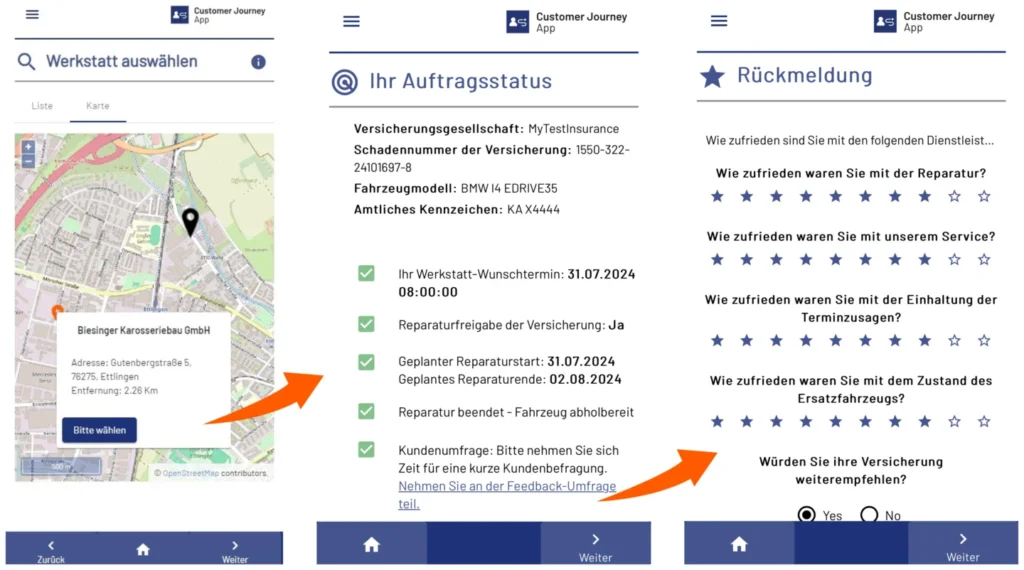
Yes – for example, with the Insurance Gateway from SoftProject. This “data hub” forms the core of claims reporting and tracking. The gateway connects insurers and service providers on a single platform. It also links applications such as web-based claims reporting with backend systems. This allows all status updates to be tracked and displayed to the end customer. Additionally, fully integrated claims reporting enables automated task assignments based on predefined rule sets.
Customers can submit claims directly in their browser, whether on a desktop or smartphone. They are guided through a questionnaire created by the insurer using predefined questions – no custom IT development required.
Fully integrated claims reporting as the foundation for dark processing
Claims submitted via the Insurance Gateway are transferred directly to backend systems, such as claims management platforms. Based on rules defined by the insurer, tasks can be assigned either automatically (dark processing) or manually by a claims handler.
Service providers connected to the gateway receive assignments automatically and can report status updates (received, in progress, invoice sent, etc.). Providers not yet connected can access a dedicated service portal, which is also integrated with the gateway. Insurers assign tasks through the portal, and service providers retrieve and complete them there. This ensures a seamless, closed-loop process.
Conclusion: Unlocking the full potential of the Insurance Gateway
The potential of the Insurance Gateway is significant. Since it stores all relevant status data, this information can also be communicated directly to customers—whether via web app, customer portal, or SMS.
Interested? Get in touch with us, and we’ll work together to find the optimal solution for integrating your processes.