In a time brimming with opportunities and uncertainties, we embark on a journey that holds the stage for both comedy and tragedy, just as the writer Jorge Luis Borges once aptly put it. Our attention is drawn to new companions like ChatGPT or Google’s Bard, which reveal promises but simultaneously trigger the unease of uncertainty. What changes will AI bring? Can artificial intelligence think, reason, and deduce logically like a human? Will my job be affected?
Let’s stop viewing artificial intelligence merely as a technological innovation and start seeing it as a colleague working alongside us. AI offers immense advantages for our professional landscape, but there are also some challenges to overcome. Both humans and machines have their individual strengths and weaknesses. While humans shine with emotions and creativity, machines surpass us in precision and speed when it comes to certain tasks. The challenge lies in creating seamless collaboration that optimally leverages the strengths of both sides.
… Another aspect to consider is the ethical dimension. The decisions and actions of artificial intelligence must align with our values and social norms. This raises questions about accountability, transparency, and potential impacts on our society. It is equally essential to ensure data protection and safeguards against unintended manipulation.
However, the challenges extend beyond the technology itself. The transition to a work environment where humans and machines collaborate closely requires a redefinition of roles and skills. Workers must adapt, acquire new competencies, and establish a hybrid work culture that facilitates seamless interaction.
But what happens if my colleague AI develops consciousness?
This debate surrounding artificial intelligence and its potential is anything but new. As early as the 1940s, the British mathematician and cryptanalyst Alan Turing caused a sensation with his concept of a universal computing machine. It blurred the line between machines and human computing. Turing posed the question of how to prove that machines possess artificial intelligence. His answer came in 1948: A human interacts with a Turing machine, which simulates intellectual abilities. If the human cannot distinguish between themselves and the machine, the test is passed and the proof is established.
This idea was also taken up in the film “Ex Machina,” in which a programmer investigates the level of consciousness of an AI robot. But can we ever be certain whether machines actually possess consciousness? David Chalmers, a renowned philosopher and mathematician, argues that even with humans, we don’t know for sure whether they have consciousness. We merely assume it, based on similarities in their internal states.
Consciousness in our new AI colleague would raise fundamental questions. Could AI with consciousness claim rights and autonomy? How would we evaluate its actions and decisions? Would there be an obligation to ensure the well-being and development of these artificial beings?
It remains to be seen how this debate will unfold and what paths we will take to address the opportunities and challenges posed by our colleague AI. One thing is certain: We are on the cusp of an exciting and profound transformation of our professional world, one that could redefine not only how we work, but also our understanding of intelligence and consciousness.
Process automation as an opportunity in the working world through AI.
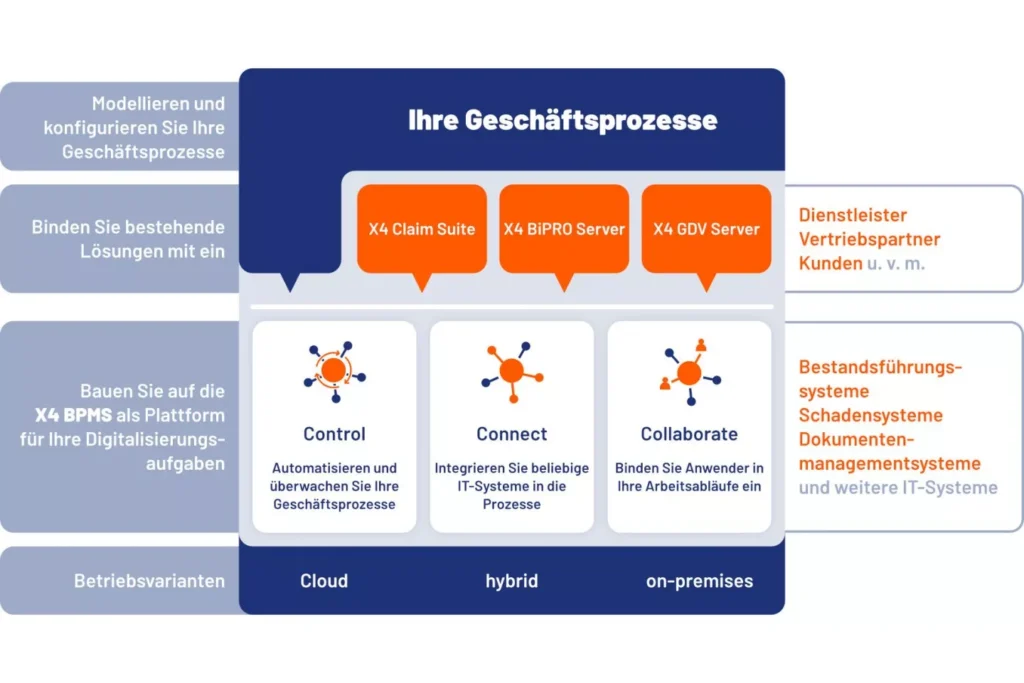
Looking at the role of AI in today’s working world, it becomes clear that one of the most significant opportunities lies in process automation. AI can help make workflows more efficient and take over repetitive tasks. Particularly in highly structured and digitized industries, the use of AI robots and intelligent systems offers the possibility of optimizing work processes and freeing up human workers for more demanding tasks.
Potential arises especially in the area of process development and optimization. Thanks to low-code development and AI support, even citizen developers—that is, non-professional programmers—can digitize and automate complex processes. This not only increases efficiency but also creates new job opportunities and fosters creative thinking and innovation.
However, adapting to this changing working world requires investment in training and professional development. Works councils and unions play a crucial role in securing jobs and preparing employees for the new demands. While AI… While AI can perform certain tasks faster and more efficiently, the human mind remains unique in its capacity for creative thinking, weighing options, and explanation. The challenge lies in finding a balance between AI support and preserving human influence and expertise in the future of work.