

Digital transformation in the public sector: connect specialist applications, registers and portals, govern the data that flows between them and automate procedures from application to decision. Build public services that citizens can rely on – and that your teams can run with fewer resources!

Picture a citizen applying for a housing allowance. Online, the form takes ten minutes. Behind the scenes, a caseworker re-types the data into a specialist application, asks the applicant for a certificate that another authority already holds, prints the notice and files a copy. The citizen sees a website – the administration still runs on paper logic.
Closing that gap is the real task. Digital transformation in the public sector is the redesign of public services so that data flows digitally from the first application to the final decision – across specialist applications, registers, portals and partner organisations – with every step traceable. It works along two complementary axes: new digital services for citizens, businesses and associations on the one hand, and the back-office processes, data flows and systems that make those services work on the other.
Germany shows why the second axis matters. The amended Online Access Act (OZG 2.0) makes end-to-end digital processing the standard for federal services. Yet in January 2026, only 823 of the 7,509 individual administrative services behind the 577 OZG service bundles were available online nationwide – and just one had reached the highest maturity level, at which forms are prefilled from public registers (IW Behörden-Digimeter 2026). In France, the same ambition runs under the banner of the “État plateforme”: administrations open their information systems via APIs so that data can circulate across their entire ecosystem.
The principle: connect each specialist application, register and portal once to a governed integration layer instead of building a new interface for every online service. The portal collects the application. The integration layer validates it, enriches it with data the administration already holds and routes it to the right specialist application. A process engine then orchestrates the caseworker tasks, approvals, deadlines and notifications until the notice reaches the citizen’s account.
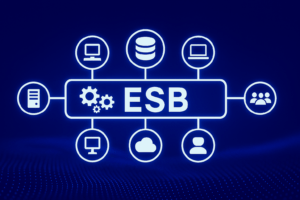
Several integration patterns work side by side on this layer. An Enterprise Service Bus (ESB) moves data between operational systems in real time. API management makes selected data available to portals, other authorities and partners under clear rules. Business Process Management turns a procedure into an executable, monitored workflow. Central monitoring shows which applications are stuck and why – so a missing document or a failed interface is fixed before the citizen has to call.

Édouard Cante
Chief Product Officer
Master Data Management (MDM) is far more than a data quality initiative. It creates a single, trusted source of truth for critical business information, enabling stronger governance, better decision-making, greater operational agility and a solid foundation for AI-driven initiatives. This practical guide explains how to successfully plan, implement and scale an MDM strategy across your organisation.
Digital transformation in government rarely fails for lack of vision. It fails in the back office. Budgets are tight, specialist staff are hard to recruit, and decades of legislation have produced procedures with countless exceptions. Many authorities run dozens of vertical applications that were never designed to talk to each other. Digitising a paper procedure “as is” only moves the problem online: the citizen fills in a web form, and the caseworker still prints it. Digitalisation and change management therefore go hand in hand – procedures need to be rethought before they are automated.
The public service mission adds constraints the private sector does not face. Every service must remain accessible to everyone, whatever their age, digital skills or location – so assisted channels at the counter have to work with the same data as the online portal. Authorities hold some of the most sensitive data there is: tax, social, health and identity data. To protect it, they need to know where it lives and who uses it. Regulation is tightening at the same time. Germany’s NIS2 implementation act has been in force since 6 December 2025, without a transition period, and brings the federal administration into a stricter information security regime. Under the EU AI Act, AI systems that decide on access to essential public services and benefits are classified as high-risk; following the Digital Omnibus agreed in 2026, obligations for stand-alone high-risk systems apply from 2 December 2027. Finally, budget rules matter: where subscription costs cannot be paid from investment budgets, on-premises operation often remains the realistic option.
The good news: public sector digitalisation can be introduced step by step – one procedure, one data flow at a time – without replacing the applications that work today. Brittany Regional Council, for example, used the Phoenix platform to urbanise all its internal and external data exchanges: applications communicate synchronously and asynchronously, and increasingly complex exchanges with external partners are orchestrated and monitored centrally – from vocational training and high schools to public transport (read the Brittany Regional Council story). Through Blueway, the SoftProject group works with French regions, départements, metropolitan areas, fire and rescue services and social housing providers.
Édouard Cante
Chief Product Officer
Simplification is the first promise – for citizens and for the people who serve them. Citizens and businesses should know where to turn, apply once, at any time and on any channel, and receive faster, more transparent answers. Caseworkers should spend their time on decisions rather than on copying data between screens. Speed matters most when it counts: in a flood or a storm, people expect support to reach them without administrative delay, and digital procedures keep public services running when offices cannot. And in a context of shrinking budgets, a lean administration has to do more with less – which only works when routine steps run automatically and every action remains traceable.
Artificial intelligence raises the stakes further. Your AI is ready. Your data isn’t. Authorities are testing AI assistants for caseworkers, chatbots for citizens and automatic document classification. These tools only help if they draw on data that is current, consistent and authorised for the purpose. In the public sector, every AI-supported step must also be explainable to citizens, auditors and courts. A governed data foundation – with documented sources, recorded lineage and clear ownership – is what turns an AI pilot into a service an authority can defend.
For IT directors and chief digital officers, digitalisation is not an end in itself. Its objectives need to be explained to elected officials, department heads and staff alike. But when is the right time to act, and what does it deliver?

Pierre Boizard
Lasting digitalisation is not a portal project – it is a backbone. Public services need applications that exchange data reliably, reference data everyone can trust and procedures that run from end to end. SoftProject brings these capabilities together on one converged platform rather than a set of separately purchased tools. It coexists with the specialist applications you already run: no big bang, one procedure at a time. And it runs where your rules require – on-premises, in a sovereign cloud or in a hybrid setup.
Connect your applications and registers. The ESB and ETL capabilities of X4 BPMS and Phoenix link specialist applications, ERP, GIS and document management systems, portals and partner organisations through one standardised exchange layer. More than 200 standard adapters replace custom interfaces, and real-time exchanges replace nightly batches. API management exposes selected data to other authorities, partners and open data portals – under clear rules and with full control.
Trust your data. Master data management establishes one authoritative version of shared reference data – staff, buildings, equipment, organisations – and distributes it to every application. MyDataCatalogue automatically maps what data exists and where, including personal data, which supports the work of your data protection officer and CISO. dataspot. adds business definitions, ownership and data lineage, so everyone knows which register is the source of truth.
Act on governed procedures. X4 BPMS and Phoenix automate administrative procedures from application to notice, combining caseworker tasks, business rules and integration in one executable process. Every step is logged as an audit trail. AI agents only access data through governed interfaces – see our approach to AI enablement and data sovereignty. To modernise step by step, read our guide to legacy system modernization in a hybrid cloud architecture.

Execute business processes with speed and reliability.
X4 BPMS enables organizations to model, automate and run business processes efficiently in daily operations. By combining human tasks, integration and process logic, X4 BPMS ensures consistent execution, faster throughput and sustainable operational improvement.

dataspot — Metadata Management & Data Lineage
dataspot adds metadata management, lineage, and data quality impact visibility, showing where data Quality is measured and how issues propagate across the data Landscape
Digital transformation in the public sector is the redesign of public services so that data flows digitally from the first application to the final decision. It covers new online services for citizens and businesses as well as the back-office processes, specialist applications, registers and data flows behind them.
Public authorities combine complex legislation, tight budgets, staff shortages and many specialist applications that were never designed to work together. On top of that, every service must remain accessible to all citizens, and sensitive data must be protected under strict rules. Projects stall when online forms are added without connecting and redesigning the processes behind them.
An online service lets citizens submit an application digitally. End-to-end digitalisation goes further: the data is validated, enriched and processed digitally all the way to the decision and the notice, without manual re-keying or paper. Only end-to-end digitalisation delivers the efficiency gains administrations need.
The once-only principle means that citizens and businesses provide a piece of information to the administration only once. Authorities then retrieve data and evidence from existing registers instead of requesting it again. It requires connected registers, reliable reference data and governed data exchange between authorities.
Data integration connects portals, registers and specialist applications through one governed exchange layer. It removes manual re-keying, keeps data consistent across departments and makes every exchange traceable. Each new online service can then reuse existing connections instead of starting another interface project.
You are currently viewing a placeholder content from Accessibility Widget. To access the actual content, click the button below. Please note that doing so will share data with third-party providers.
More InformationYou are currently viewing a placeholder content from Vimeo. To access the actual content, click the button below. Please note that doing so will share data with third-party providers.
More InformationYou are currently viewing a placeholder content from YouTube. To access the actual content, click the button below. Please note that doing so will share data with third-party providers.
More InformationYou need to load content from reCAPTCHA to submit the form. Please note that doing so will share data with third-party providers.
More InformationYou are currently viewing a placeholder content from TrustIndex. To access the actual content, click the button below. Please note that doing so will share data with third-party providers.
More Information