SoftProject and PSI Introduce Interface Between SNAP and PSIneplan
As the energy transition progresses and various sectors become electrified, we are moving toward the efficient and climate-neutral use of resources. To achieve this, numerous facilities must be integrated into the energy grids and operated safely. Various laws (EnWG, EEG, GNDEW) define the framework, although additional technical constraints must also be taken into account. Grid operators must implement the integration of these facilities and ensure a secure energy supply. For this reason, the operator must submit the required grid connection application in advance of the facility integration. In the use case between SoftProject and PSI, an automated grid compatibility check is being developed. This represents another important step toward the digitalization of the grid infrastructure.
What is a grid compatibility assessment?
A grid compatibility assessment is a technical analysis designed to ensure that the power grid is not overloaded by new installations such as solar power systems, wind turbines, or other distributed generation sources. The assessment evaluates both the capacity of the grid infrastructure and compliance with stability criteria.
Objectives of the Grid Compatibility Assessment
- Ensuring grid stability: Preventing overloads and grid disruptions.
- Optimizing grid resources: Efficient use of existing infrastructure.
- Integrating renewable energy: Promoting the energy transition through sustainable grid integration.
Grid Compatibility Assessment: Legal Framework
The grid compatibility assessment is based on the provisions of the Energy Industry Act (EnWG) and the Renewable Energy Ordinance (EEV). Grid operators are required to conduct a grid compatibility assessment before new feed-in facilities are connected to the grid.
Key Legal Requirements
- Section 14 of the Energy Network Act (EnWG): Ensuring non-discriminatory grid connection.
- Renewable Energy Act (EEG) 2023: Promoting the integration of renewable energy while ensuring grid compatibility.
Wichtige gesetzliche Anforderungen
§ 14 des Energienetzgesetzes (EnWG): Gewährleistung eines diskriminierungsfreien Netzanschlusses.
Erneuerbare-Energien-Gesetz (EEG) 2023: Förderung der Einbindung erneuerbarer Energien bei gleichzeitiger Gewährleistung der Netzverträglichkeit.
Automated Grid Compatibility Assessment
Generally, the grid connection application process follows specific steps and requires the submission of a formal application to the relevant grid operator. This involves providing detailed information about the planned system (e.g., capacity, location, technology). The application collects the information necessary to assess grid compatibility. The applicant must specify, among other things: Where is the grid connection point (address / parcel number / GEO data)? What type of system is planned (PV system, storage, heat pump)? When is the project scheduled? In the spirit of customer self-service, the applicant can apply for grid connection online at any time. The application is evaluated via PSIneplan on the PSIconnect system platform.
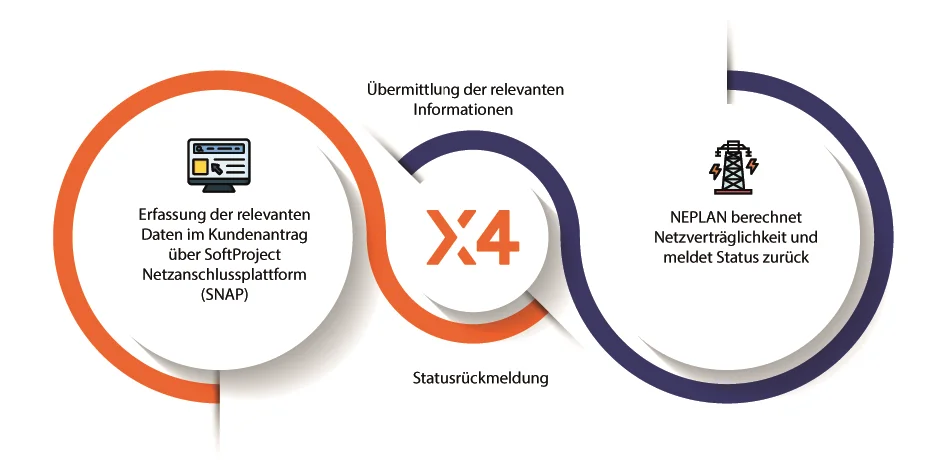
Technical Implementation
A distribution network operator is responsible for every location in Germany. On the VNBdigital.de website, applicants can find the relevant network operator and submit their individual grid connection application. Data from the customer application is entered via the SNAP grid connection platform and transmitted through the company’s grid connection portal. The goal is for customers to learn from distribution network operators whether a grid connection is possible at a selected location. The case handler at the energy supply company (EVU) can view the application and receives fully automated feedback on grid compatibility. This is facilitated through communication between SNAP and PSIneplan. The review and technical assessment of whether the existing grid infrastructure can accommodate additional installations is reported back. This automated review significantly reduces the workload for the case handler at the energy supply company. Depending on the result, the system can be implemented immediately or after grid expansion has been completed. This assessment is performed using PSIneplan and takes into account the latest planning principles and technical framework conditions (VDE application guidelines) regarding voltage stability and load behavior of the energy infrastructure.
Once approval has been granted, the system is installed and commissioned. Once this has been completed by the installer, the grid connection completion notification is submitted, and data can be automatically imported into relevant smart grid apps, such as PSIngo, via the PSIconnect system platform. An intelligent, § 14a EnWG-compliant low-voltage automation system that monitors and regulates (“dims”) the current grid status, making it a particularly important tool for the grid operator.
With efficient and reliable grid status monitoring, real-time measurement values can be transmitted and taken into account for connection requests, thereby elevating the technical connection assessment to a higher level.

Overall, SoftProject’s digital network connection process eliminates the need for paper and media breaks and effectively connects departments, service providers, and customers. With the PSIconnect platform, all relevant stakeholders are integrated into the process via their own applications.
Benefits of an Automated Grid Compatibility Assessment
- Simplified grid connection requests with efficient coordination
- High data quality through automated processes
- Automated processing of standard cases
- Significant time savings for staff and departments
- Complete documentation of results
- Flexible reporting options
- Monitoring of processes and deadlines
The implementation of automated grid compatibility testing marks an important first step. The grid data used for testing consists of values from connected facilities and connection requests submitted at a given point in time. At this stage, the ongoing digitization and efficient process design of data across departmental boundaries continues. The new regulations on the integration of controllable consumer devices, effective since January 2024, are key to grid-oriented control for grid operators and simultaneously enable a wide range of additional value-added services. This enables effective and digital grid management.