How to Digitally Accelerate Claims Processing and Increase Customer Satisfaction
The competition never sleeps: Insurers must communicate ever more efficiently with their service providers, and customers want to reach their insurer immediately in the event of a claim – whether by phone, call, or online via chat, an app, or a customer portal. Digitalization platforms offer a solution to these challenges, as companies can easily integrate them into their existing infrastructure. They connect people, systems, devices, data, and documents, structuring and managing data in a way that automates business processes. The advantages are clear: accelerated workflows, faster response and processing times, fewer errors, reduced costs, and ultimately, greater competitiveness.
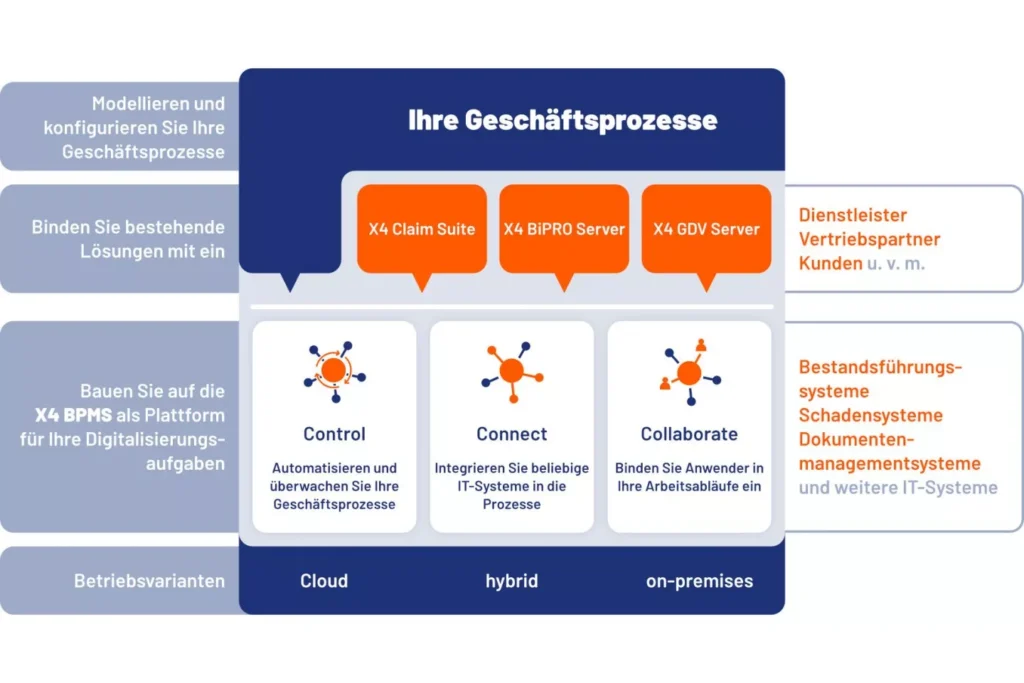
According to a representative study by the digital association Bitkom from 2019, more than half of 16- to 29-year-olds in Germany would already prefer fully digital communication and claims processing with their insurer. Among 30- to 49-year-olds, the figure is still 46 percent. This sends a clear signal to insurers to react as quickly as possible and expand their digital offerings – ideally with maximum security and minimal effort. The market offers tried-and-tested, pre-built industry solutions such as the Claim Suite, which is based on the X4 BPMS digitalization platform. Up to 80 percent of the functions to be automated, such as rule-based service provider commissioning, communication, and controlling, can be obtained from the cloud and are ready for immediate use, while only 20 percent require individual customization. The solutions are ready for immediate deployment, significantly reducing development effort compared to custom solutions, and thus lowering costs and expenses.
Tried-and-tested claims management: Application examples from daily use
Industry solutions like the Claim Suite, which enables such automated processes, can be easily integrated into existing IT landscapes. Insurers and service providers can use the Claim Suite in a cloud-based or hybrid solution: While some companies deploy their applications, services, and data entirely via cloud computing platforms such as Google Cloud Platform, Amazon Web Services (AWS), Red Hat OpenShift Online, or Microsoft Azure—for example, to benefit from flexibility and reduced maintenance costs—others prefer a hybrid approach combining cloud and on-premises solutions. A hybrid operating concept offers the advantage that the connection of back-end systems and company-specific processes is operated in the company’s own data center, while typical industry processes, such as connecting service providers, can be outsourced to the cloud, as these connections can be used by any insurer.
Pay attention:
Digitalization platform ≠ Digitalization platform
Functional interfaces between existing IT systems are crucial for the smooth operation of automated processes. Without the unimpeded import and export of data, for example, between the insurer and the connected claims service provider, process automation is impossible. Special adapters that convert formats and make systems compatible ensure an unhindered data flow, thus enabling automated processes. When selecting a digitization platform, it is essential that it has industry-specific adapters and connectors and can handle all digitization tasks as a central platform. Otherwise, digital patchwork landscapes with isolated information silos and process-inhibiting media breaks can quickly arise. It is important to note that the designs, definitions, and functions of digitization platforms vary considerably on the market.
Functional interfaces are crucial for a smooth process.
One criterion, also with a view to future digitization projects, should be that the digitization platform is scalable to meet increasing demands. Here’s some good news for insurance companies that have already invested in digitized processes or plan to do so soon: the more sub-processes are automated, the easier further digitization becomes. For example, already digitized processes can be reused, thus reducing the effort required for further digitization projects.
Seize opportunities: Gain a competitive edge with a digitalization platform
In general, every company can and should use a digitalization platform – not only to meet market and customer demands, but also to control the total cost of ownership and remain competitive. A representative survey conducted by the digital association Bitkom in 2019 shows that 42 percent of the companies surveyed admit that competitors who embraced digitalization early on are now ahead of them. Numerous forward-thinking insurance companies have recognized the need and are already digitalizing industry-specific processes. They are focusing on end-to-end electronic claims processing, automated service provider management, and portal and self-service solutions for their customers. And so, the desire for fully digitalized and efficient communication between all parties involved – from the insurer to the service provider to the end customer – may soon be fulfilled.